
Who are we ?
What is APIA SWISS?
Purpose of the association
The APIA Swiss association aims to be the center of excellence in SME governance. Our members, who are company directors, are the key contacts for SME managers.
APIA's mission is to promote and professionalize through his actions and collective work the function of Independent Director.
APIA firmly believes that good governance guided by the social interest contributes to the company's sustainable performance. In our view, the social interest encompasses four aspects: the long-term viability of the company as a legal entity, the interests of the shareholders, their contribution to the company's project, and the creation of value for stakeholders.
We favor a pragmatic approach tailored to the context of SMEs. It is based on the independence and professionalism of our members, whose actions aim to disseminate good governance practices with the ultimate goal of business performance and not just compliance.
Origin
APIA Swiss is a Swiss non-profit association founded in January 2018.
APIA was founded in 2003 in France by business leaders active in Boards of Directors or Supervisory Boards.
APIA France today it has more than 200 active members and more than 30 partner companies.
APIA's motto is "business leaders talking to business leaders".
The members of the association's Steering Committee are:
- President, Serge Reymond
- Treasurer, Grégoire Bouille
- Secretary, Eric Maire
- Christophe Marchal
- Anne-Laure Héritier
- François Bouteiller
- José Veloso
Goals
For the coming years, APIA Swiss has set itself the following objectives:
- Promoting good governance practices in SMEs,
- To increase its visibility and integration into the SME ecosystem with the ever-increasing support of its partners,
- To continuously strengthen the competence of its members as independent directors,
- To grow the number of its members while maintaining a high level of standards.
- To develop first in French-speaking Switzerland, then gradually throughout Switzerland via regional sections.
APIA hopes in this way to contribute in its own way to the competitiveness of the Swiss economy.
Means
The association is funded by membership fees, support from partner companies and sponsors.
APIA Swiss pursues its goal through the following means:
- The creation of an ethical and professional framework through collaborative actions involving exchange and synthesis, bringing together members and partner companies.
- Communication through testimonials of experiences and governance practices relevant to business stakeholders. The association is particularly committed to giving a voice to business leaders whose experiences highlight the importance of professionalizing governance bodies.
Purpose of the association
The APIA Swiss association aims to be the center of excellence in SME governance. Our members, who are company directors, are the preferred partners of SME leaders.
APIA's mission is to promote and professionalize the role of Independent Director through its actions and collective work.
APIA firmly believes that good governance guided by the social interest contributes to the company's sustainable performance. In our view, the social interest encompasses four aspects: the long-term viability of the company as a legal entity, the interests of the shareholders, their contribution to the company's project, and the creation of value for stakeholders.
We favor a pragmatic approach tailored to the context of SMEs. It is based on the independence and professionalism of our members, whose actions aim to disseminate good governance practices with the ultimate goal of business performance and not just compliance.
Origins
APIA Swiss is a non-profit association founded in January 2018.
APIA was founded in 2003 in France by business leaders active in Boards of Directors or Supervisory Boards.
APIA France today it has more than 200 active members and more than 30 partner companies.
APIA's motto is "business leaders talking to business leaders".
Organization
The members of the association's Steering Committee are:
- President, Olivier Bedat
- Vice-President, Daniel Brandenburger
- Secretary, Eric Maire
- Treasurer, Grégoire Bouille
- Jean-Christophe Barth
- François Bouteiller
- Fouad Dadi
Goals
For the coming years, APIA Swiss has set itself the following objectives:
- Promoting good governance practices in SMEs,
- To increase its visibility and integration into the SME ecosystem with the ever-increasing support of its partners,
- To continuously strengthen the competence of its members as independent directors,
- To grow the number of its members while maintaining a high level of standards.
- To develop first in French-speaking Switzerland, then gradually throughout Switzerland via regional sections.
APIA hopes in this way to contribute in its own way to the competitiveness of the Swiss economy.
Means
The association is funded by membership fees, support from partner companies and sponsors.
APIA Swiss pursues its goal through the following means:
- The creation of an ethical and professional framework through collaborative actions involving exchange and synthesis, bringing together members and partner companies.
- Communication through testimonials of experiences and governance practices relevant to business stakeholders. The association is particularly committed to giving a voice to business leaders whose experiences highlight the importance of professionalizing governance bodies.
Governance
Governance Governance is a set of processes and rules defining how a company should be managed and controlled to best protect the interests of its stakeholders. While legally mandated for large companies, governance is less prevalent in organizations not required to adopt it. APIA's approach for small and medium-sized enterprises is to move beyond restrictive governance towards positive governance, which creates value for the company and its stakeholders.
The independent administrator must be free from any conflict of interest with respect to the company of which they are a member of the board of directors, supervisory board, or strategic council. They contribute, through their competence, experience, and independent judgment, to ensuring its effective operation. They cannot be in a position likely to impair their judgment and independence of mind, nor can they be in a situation of conflict of interest.
The social interest The company's best interests are those of the corporation, a legal entity, which transcend the personal interests of shareholders or partners. This serves as the independent director's compass: Is a given decision likely to promote or jeopardize the company's long-term viability? Does it serve the interests of the partners? Does it contribute to the company's strategic plan? Does it create value for stakeholders?.
The administrator's compass
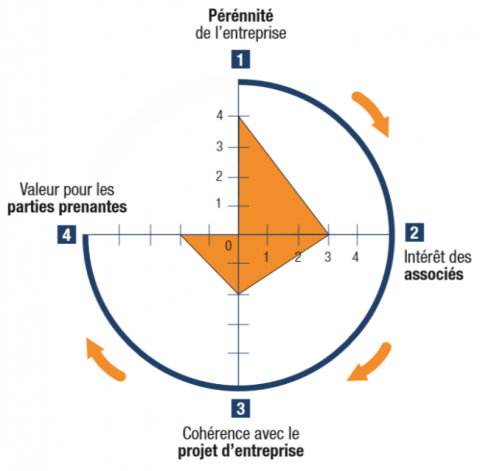
It then constitutes the compass for leaders, a form of imperative for conduct that requires respecting an interest greater than one's personal interest.
The Independent Director's Compass: The Company's Social Interest
The different roles of the administrator:
Part of the appeal of the role of director lies in the wide variety of situations and stakeholders the director will encounter. Beyond the diverse range of responsibilities, they will be confronted with different phases of the company's life cycle, each requiring a different role. We have identified seven distinct roles that a director may be called upon to fulfill throughout their term, some of them simultaneously.
- Become a member or partner of APIA,
- Or perhaps you are considering the presence of an Independent Director in your company's governance,